
Mission
About
Archive
Submit
Newsletter
PAST ISSUES:
16. Transformative Fashion Pedagogies
15. Southeast Asia
14. Barbie
13. Fashion & Politics
12. Border Garments
11. Digital Engagement
10. Partnership
9. Fall 2021
8. Mental Health
7. Motherhood
6. Fall 2020
5. The Industry
4. Summer 2017
3. Spring 2017
2. Winter 2016
1. Fall 2016

Wafa Ghnaim is an art and dress historian, fashion researcher, embroiderer, educator, and the founder of the Tatreez Institute, specializing in Palestinian embroidery and adornment. She is the author of Tatreez & Tea (2016) and THOBNA (2023), with research published by the Metropolitan Museum of Art, the Art Institute of Chicago, and the National Gallery of Singapore. A former instructor at the Smithsonian and Research Scholar at the Metropolitan Museum of Art, she now continues her preservation work as a Research Fellow supported by the Mellon Foundation at the Museum of the Palestinian People, and a designer for Victoria & Albert Museum’s Thread Memory: Embroidery from Palestine.
Author photo by Ashraf Hussein.
In today’s fast fashion economy, the Palestinian woman’s thobe (dress) is increasingly subject to the forces of mass production and global consumption. Machine embroidery, once a supplementary technique used to adorn the thobe in the early twentieth century, has become central to a growing sector of dress manufacturing that prioritizes speed, cost-efficiency, and consumer accessibility. This shift comes at the expense of the basic principles that define Palestinian embroidery (tatreez) as one form of cultural heritage, especially in the motifs stitched into the thobe that reflects the maker’s regional identity, stories about her life, and the symbolism imbued in each pattern. [1] Historically, the thobe required months—or even years—of collective work by hand. Now, it can be produced in a matter of hours, for any purpose and in any design. [2] The widespread circulation of factory-made embroidered dresses across Palestine and the diaspora has contributed to an obscured understanding of the traditional dress among Palestinians in the diaspora, collapsing the distinction between hand and machine production into a single, undifferentiated category. Palestinian consumer knowledge trumps traditional knowledge, in consequence, eroding the distinctions between each technique and their place in history. The rupture of visual literacy in the Palestinian diaspora can arguably be attributed to the popularization of machine-made embroidery, raising critical questions about authenticity, sources of designs, and sites of production that claim Palestinian origin, as well as the broader commodification of cultural heritage within globalized fashion systems. The three modes of production—handmade, small workshops using human guided machines, and industrially produced garments with minimal human oversight—must be understood not as variations of a single handmade tradition, but as fundamentally distinct techniques that carry different cultural meanings, social histories, and economic implications. While machine embroidery has broadened access to tatreez across economic backgrounds, it has also reinforced a hierarchy of authenticity—one that reinforces class-based distinctions between those who can afford hand-embroidered garments and those who cannot. [3] The rise of mass-produced, fast fashion-inspired garments has also prompted debate over its role in cultural preservation, the harms of commodification, and questions of authenticity in machine-made Palestinian dresses. In exile, these dynamics raise ethical questions about how machine-made dresses with Palestinian patterns are produced, marketed, and culturally valued.
 Detail of an early twentieth century thobe from Al Majdal, Gaza, with machine-embroidered flowers and vines added during the mid-twentieth century. The single running stitch by hand using black embroidery thread intersects with the machine embroidered running stitch in tan-colored thread. The purple stripe, now faded to pink, is characteristic of the traditional fabric woven in Al Majdal during the first half of the twentieth century. The Tatreez Institute Collection. Photograph by the author.
Until the mid-twentieth century, Palestinian women primarily embroidered their dresses by hand, with regional variations in tatreez (embroidery) signifying social status, familial lineage, and village identity. [4] When mechanized embroidery was first introduced into Palestine in 1928 by the Singer Sewing Machine Company, it was welcomed as a symbol of affluence and technological progress and viewed with apprehension. Helaneh Silhy, an embroiderer from Bethlehem, was interviewed by renowned Palestinian dress collector and historian Widad Kawar. Silhy enrolled in the first embroidery course offered by Singer, demonstrating such exceptional skills that the company invited her to teach machine embroidery to other women in nearby villages. Widad Kawar recounts that “Helaneh was faithful to the traditional patterns and used them in machine embroidery, but some women objected to her work because it would make their handiwork redundant. Some embroiderers saw this as a threat to their own business.” [5] Nonetheless, mechanized embroidery became increasingly popular with villagers, who expanded their work from dresses to tablecloths, bed sheets, and children’s clothes. [6] During this era, Palestinian women viewed machine-made embroidery as a sign of prestige and luxury, and “a mark of wealth, status, and high fashion.” [7]

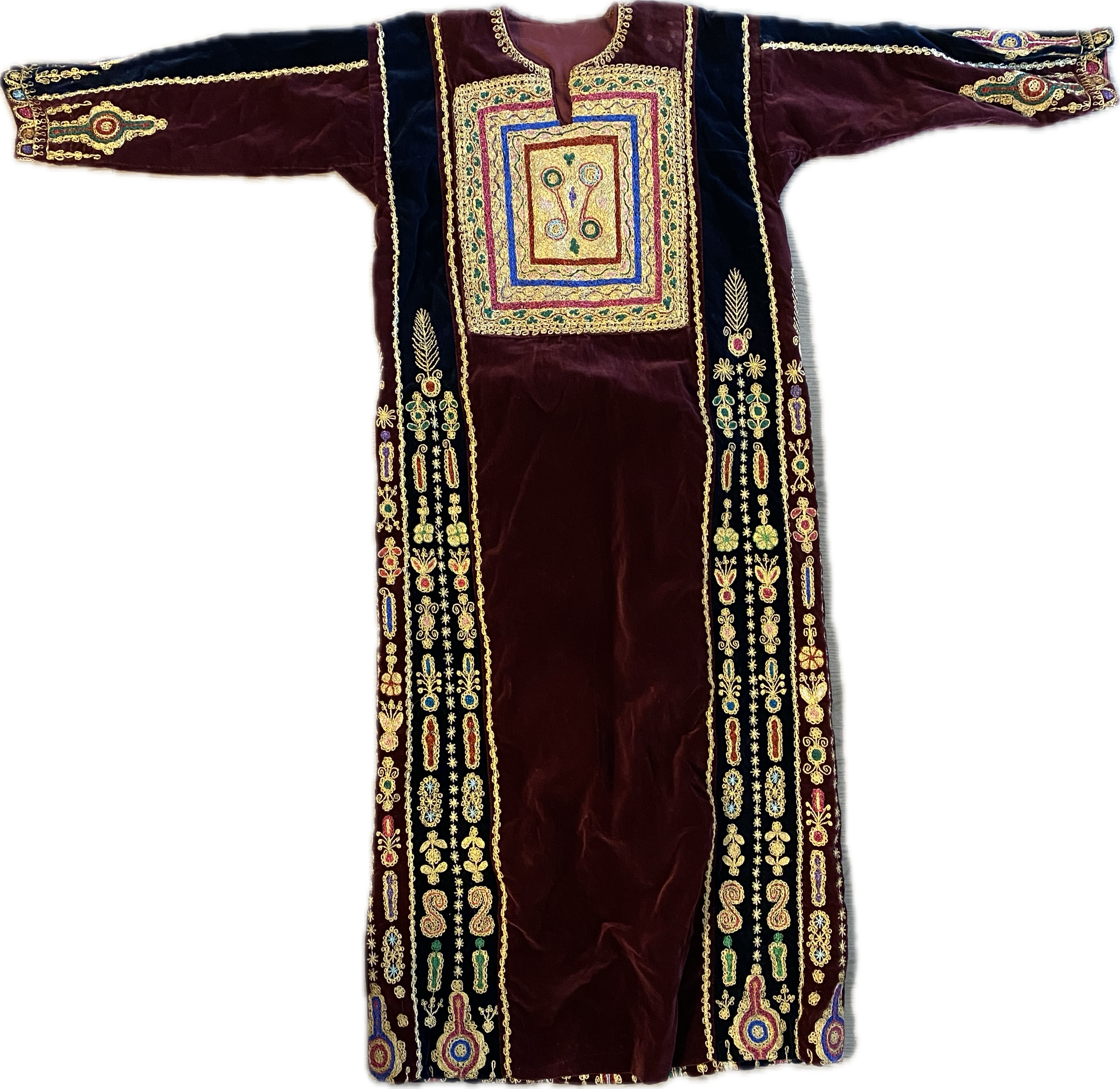
Maker Once Known, Six Branch Dress (Non-Regional Dress Style), 1960s. The Tatreez Institute Collection. Photograph by the author.
“[M]any consumers perceive machine embroidery as a monolithic category, despite the fact that it encompasses divergent methods, varying aesthetics, and cultural contexts.”
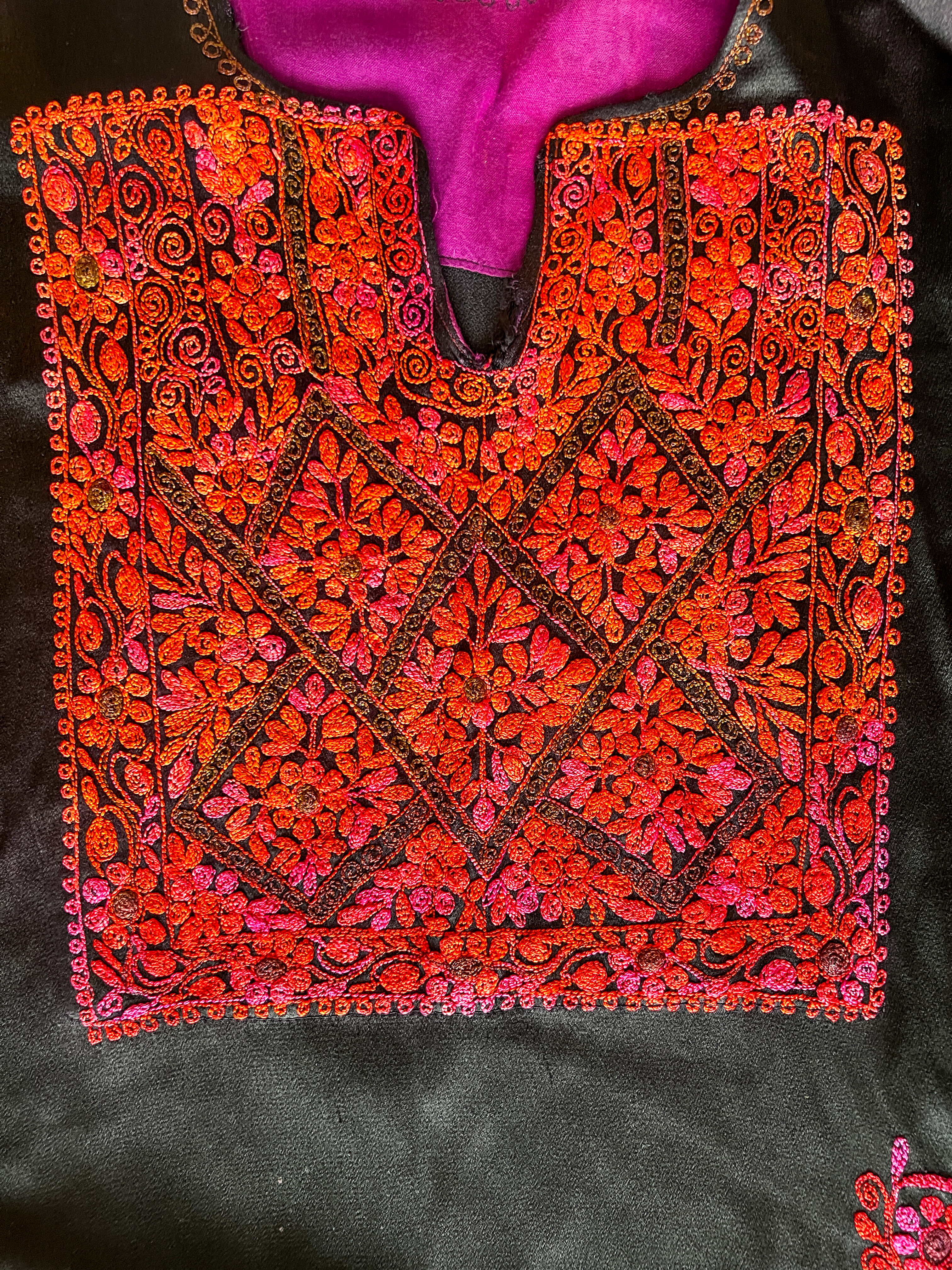
After the mid-twentieth century and the 1948 Al Nakba, during which over 750,000 Palestinians were forcibly displaced for the establishment of Israel, Palestinian women could no longer engage in embroidery as they once did in their villages, due to strained economic conditions, overcrowding in refugee camps, and the loss of livelihood. In the aftermath of the war, machine-embroidered dresses continued to grow in popularity, emerging alongside hand embroidery practices that have nonetheless persisted across Palestine, within refugee camps, and throughout the diaspora. These machine-embroidered dresses were vibrantly colored and meticulously constructed. The Tatreez Institute collection includes one such example: a bright red, orange, and pink embroidered thobe on black synthetic fabric, produced entirely through mechanized techniques using the zigzag function—critical for producing couched and satin stitches—possibly introduced to the consumer market by the Singer 206K Electric Sewing Machine in 1936. [8] While automated stitching significantly expedited the production process, the embroiderer would still have manually guided each laid thread using both hands and a foot pedal, rotating the fabric, changing threads, and attending to the needle. The resulting thobe reflects a high level of craftsmanship, making sophisticated use of the mechanized tools available at the time. This particular dress bears a single hand-worked running stitch at the hem of the skirt, showing the personal touch of the maker, as well as her close adherence to tradition. [9]
Conflicting beliefs within the Palestinian community regarding hand versus machine embroidery born in the era of Helaneh Silhy persist today. Many fear that mechanized production may further endanger traditional knowledge systems, rituals, and practices that are embedded in the practice of Palestinian embroidery. [10] As stated in the nomination file accompanying the 2021 UNESCO inscription of Palestinian embroidery on the Representative List of the Intangible Cultural Heritage of Humanity, among the most pressing threats to the continuation of traditional tatreez is embroidery mechanization itself. “The entry of machines into embroidery led to the deterioration of this art. As the high prices of handmade embroideries contributed greatly to the replacement of hand-made embroideries with the pieces done by machines because they are less expensive, especially since the Palestinian people generally has limited income. Hence patterns of cheap embroideries of ugly settings may distort this art.” [11]
Conflicting beliefs within the Palestinian community regarding hand versus machine embroidery born in the era of Helaneh Silhy persist today. Many fear that mechanized production may further endanger traditional knowledge systems, rituals, and practices that are embedded in the practice of Palestinian embroidery. [10] As stated in the nomination file accompanying the 2021 UNESCO inscription of Palestinian embroidery on the Representative List of the Intangible Cultural Heritage of Humanity, among the most pressing threats to the continuation of traditional tatreez is embroidery mechanization itself. “The entry of machines into embroidery led to the deterioration of this art. As the high prices of handmade embroideries contributed greatly to the replacement of hand-made embroideries with the pieces done by machines because they are less expensive, especially since the Palestinian people generally has limited income. Hence patterns of cheap embroideries of ugly settings may distort this art.” [11]

But, machine embroidery has introduced new forms of accessibility, affordability, and innovation for Palestinian women living under the harsh conditions of the Israeli occupation and in refugee camps. In the face of deepening economic precarity, home demolitions, and violence, machine embroidery has become a practical means of cultural connection to “own a piece of tradition and express their identity on their body.” [12] In 2015, Palestinian embroiderer Um Yasmine Abu Oueily living in Gaza Strip shared, “Frankly, I have no embroidered pieces to wear because such pieces are costly, and I buy yarn to make embroideries for others. I make about $50 a month.” [13] Machine-made dresses have enabled the continuation of embroidery as both an embodied cultural expression and a source of livelihood, supporting local economies and responding to the growing demand for embroidered garments in an unstable economic and political landscape caused by the Israeli occupation.[14] The presumption that handmade embroidery is more authentic than machine-made is a relatively modern perspective within the Palestinian embroidery world, more pronounced as consumers become increasingly aware of the harmful environmental impacts of fast fashion despite its use in Palestinian dressmaking for the better part of the last century.
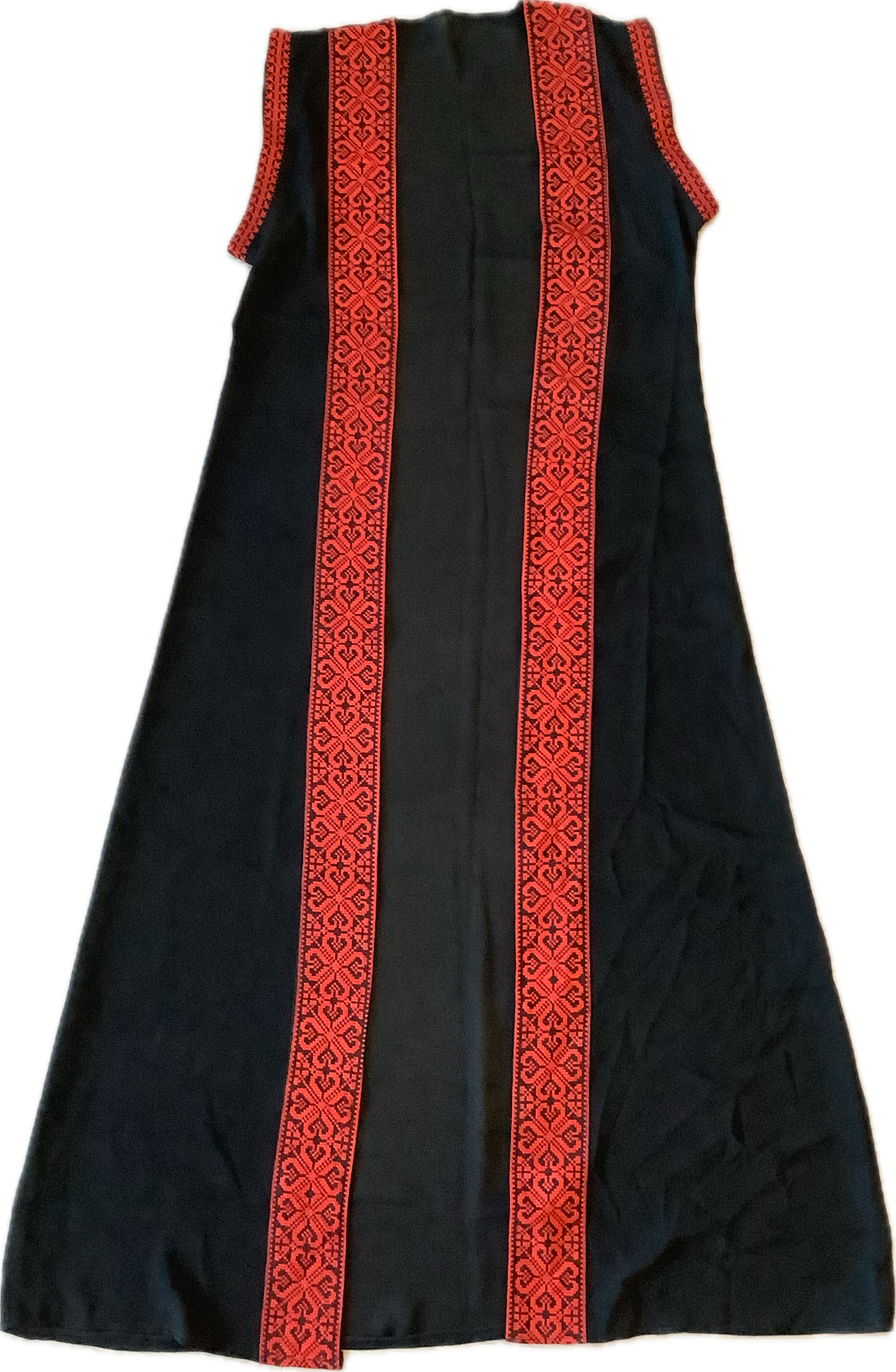
In my examination of twentieth-century Palestinian dresses within the Tatreez Institute collection, machine embroidery appears to have been carried out primarily by individual Palestinian makers and small embroidery workshops. These embroiderers developed technical proficiency in operating embroidery machines and exercised a degree of creative agency in motif selection, color combinations, and compositional layout that often mirrored traditional formats. A wide array of motifs—executed in diverse colors, threads, and techniques—can be observed on dresses produced well into the 1990s, signaling a continued effort to preserve traditional aesthetics within the evolving medium of machine embroidery. As Wissam Balchi, a Palestinian embroiderer and shopkeeper in Abu Dhabi said to me in 2019, “Not all machine embroidery is produced in the same way. The women I work with sit at the embroidery machine and create each piece” she remarked, underscoring the varying levels of quality that exist in the world of machine embroidery today.
In my examination of twentieth-century Palestinian dresses within the Tatreez Institute collection, machine embroidery appears to have been carried out primarily by individual Palestinian makers and small embroidery workshops. These embroiderers developed technical proficiency in operating embroidery machines and exercised a degree of creative agency in motif selection, color combinations, and compositional layout that often mirrored traditional formats. A wide array of motifs—executed in diverse colors, threads, and techniques—can be observed on dresses produced well into the 1990s, signaling a continued effort to preserve traditional aesthetics within the evolving medium of machine embroidery. As Wissam Balchi, a Palestinian embroiderer and shopkeeper in Abu Dhabi said to me in 2019, “Not all machine embroidery is produced in the same way. The women I work with sit at the embroidery machine and create each piece” she remarked, underscoring the varying levels of quality that exist in the world of machine embroidery today.


“[M]achine embroidery may not signal a rupture but rather a recalibration: a mode of connection for a people scattered by exile and bound by a sense of longing.”
Palestinian machine embroidery today appears to be produced in Palestine, Jordan, and even China, but the true origin of production is rarely labeled or disclosed in the marketplace. As a result, many consumers perceive machine embroidery as a monolithic category, despite the fact that it encompasses divergent methods, varying aesthetics, and cultural contexts. Since the early 2000s, machine embroidery has seemingly splintered into at least two dominant forms: small-batch embroidery—often still informed by traditional design sensibilities—and industrialized embroidery, which prioritizes standardization and speed. These are not merely stylistic variants but signal broader differences in materials, stitch appearance, pattern choices, and thread colors.
Now, industrialized thobe production in factories has become increasingly popular due to its low-cost manufacturing, consumer affordability, and capacity for rapid customization. Tajima brand embroidery machines, which are widely used across the region and supported by an active sales office in Jordan, are capable of producing embroidery for hundreds of dresses per day, significantly reducing the labor costs associated with each garment. This level of automation allows for quick transitions between motifs and materials with minimal downtime, supporting high-volume production. [15] In many cases, these machines operate with limited human oversight, reflecting a broader shift in the global fashion industry where the social and cultural value once embedded in handmade garments is increasingly overshadowed by the imperatives of speed, scalability, and profit. Further research is needed to disentangle the conditions under which machine-embroidered garments are produced: Who is designing and deciding on these motifs? Who programs the machines? How much human intervention is involved in factory production compared to that of embroidery workshops?
Now, industrialized thobe production in factories has become increasingly popular due to its low-cost manufacturing, consumer affordability, and capacity for rapid customization. Tajima brand embroidery machines, which are widely used across the region and supported by an active sales office in Jordan, are capable of producing embroidery for hundreds of dresses per day, significantly reducing the labor costs associated with each garment. This level of automation allows for quick transitions between motifs and materials with minimal downtime, supporting high-volume production. [15] In many cases, these machines operate with limited human oversight, reflecting a broader shift in the global fashion industry where the social and cultural value once embedded in handmade garments is increasingly overshadowed by the imperatives of speed, scalability, and profit. Further research is needed to disentangle the conditions under which machine-embroidered garments are produced: Who is designing and deciding on these motifs? Who programs the machines? How much human intervention is involved in factory production compared to that of embroidery workshops?

To investigate these questions, I commissioned researchers in Amman and Ramallah to survey shopkeepers and document the production landscape of machine embroidery. Some of the questions posed included: Where is your inventory of machine-embroidered clothing made? Is the place of production typically labeled? Are there noticeable differences between embroidery produced in Jordan, Palestine, and China?
In Amman, researcher Wafaa Hussein found that shopkeepers were largely unwilling to answer directly—particularly when asked where the dresses were produced. Such questions were treated as proprietary information, suggesting a deeper market dynamic in which the commercial structures supporting machine embroidery rely on a degree of secrecy to maintain profitability. Jordanian shopkeepers selling machine-embroidered dresses with Palestinian patterns often avoid disclosing whether the garments were produced in Palestine, perhaps because a “Made in Palestine” association is perceived to heighten the dress’s cultural value. Hussein also noted a prevailing social distinction in Jordan: while the selling of machine embroidery is widely regarded as a commercial enterprise, the making and selling of hand embroidery is viewed as a cultural responsibility.
In contrast, the 11 businesses surveyed by researcher Wissam Saleh in Ramallah were more forthcoming. Price was unanimously cited as the primary reason business owners and customers choose machine embroidery over hand embroidery, with speed of production and neatness of stitches as secondary considerations. Of the 11 businesses, nine reported at least 50% of their production in Palestine, four produced exclusively in Palestine, and two imported entirely from Jordan. Nearly all shopkeepers acknowledged that the majority of machine-embroidered dresses in the Palestinian market were made in Jordan, where lower labor costs make production cheaper—even for garments that look fully “Palestinian.” In Ramallah, higher production costs are compounded by the Israeli occupation: checkpoints, roadblocks, and permit systems restrict the movement of workers and goods, while shipment delays raise costs and make it difficult to maintain consistent quality. [16] Shopkeepers frequently asserted that Palestinian-made embroidery is of higher quality, citing differences in stitch thickness, thread type, and fabric choice. Jordanian products were often described as “lighter,” “commercial-grade,” or “lower quality,” though a minority argued there is no difference if specifications are precise. Crucially, Jordanian workshops can produce embroidery patterns that are virtually indistinguishable from Palestinian tatreez, making the visual authenticity of the patterns an unreliable indicator of a garment’s origin.
Nevertheless, shopkeepers in Ramallah noted that small embroidery workshops produce the most colorful, detailed designs, while large factories manufacture garments with simplified, repetitive motifs, often in monochrome. Machine embroidery imported from China is difficult to differentiate with those made in Jordan; however, it generally follows the same characteristics that depend on large-scale replication of a single motif. In contrast, small workshop production, like those in Palestine and Jordan, still reflect traditional design choices, even as it embraces mechanized techniques.
These preliminary findings suggest that the market for machine-made Palestinian embroidery relies, to some degree, on a lack of transparency in its production origins. The survey data reveal three measurable patterns: first, machine-made tatreez retains a strong appeal for consumers outside Palestine seeking to connect with their cultural heritage; second, Jordanian production remains the dominant source in the Palestinian machine-made market; and third, price point often serves as a proxy for Palestinian cultural heritage. Higher-priced garments are more likely to be presented as made in Palestine, while cheaper items are more often associated with Jordan. Notably, none of the garments carry labels indicating their place of origin. Although this data set is incomplete, these preliminary observations offer a starting point for more comprehensive research into this topic.
![]()
A stack of folded dresses featuring both machine- and hand-embroidered pieces from various time periods. While these garments differ categorically in process, technique, and material, the proliferation of machine-made dresses has contributed to a diminished understanding among Palestinians of the distinctions between handmade and mechanized embroidery. Tatreez Institute Collection. Photograph by the author.
The long-term effect of fast fashion in tatreez has yet to be fully understood. On the one hand, the removal of the human dressmaker from the process of creating what was once a deeply personal expression of cultural identity has contributed towards a growing devaluation of the handmade. Mass-produced motifs, replicated with mechanical precision, have further obscured distinctions between generic designs and traditional patterns once sacred to Palestinian cultural heritage. As a result, there has been a significant loss of traditional knowledge, particularly in the language of embroidery that once told the story of a woman’s life, her family, and her village. Even the ability to discern handwork from machine stitching has weakened, leading to widespread misinterpretations of dress history: garments produced before 1948, rich with village- and region-specific motifs, are frequently confused with national-style thobes created after the Nakba—such as the “six-branch” dress—and with post-Y2K iterations that bear little trace of the maker’s biography or geographic origin. [17, 18]
While some culture workers express concern about the survival of hand embroidery, others, like Rachel Dedman, offer a more expansive and nuanced view. Dedman suggests that “those inspired to learn tatreez are, in doing so, making the space between them and Palestinian women, particularly those suffering in Gaza, a little bit smaller. It’s an act of connection as much as of craft. The machine-made embroidery, on the other hand, is perhaps made accessible to people who don’t have the luxury of hand-stitched items.” [19] In this light, machine embroidery may not signal a rupture but rather a recalibration: a mode of connection for a people scattered by exile and bound by a sense of longing. Perhaps the challenge is not simply to preserve the visual lexicon of tatreez as it once was but to acknowledge the shifting forms through which cultural memory now travels. In an era defined by displacement, digital communication, and the violence of ongoing erasure, machine-embroidered dresses may offer one path for Palestinians to bridge generational and geographic divides. Though the story of the individual maker may disappear in the perfectly stitched synthetic threads, our collective desire to reimagine a Palestinian future endures. At its core, the persistence of tatreez—in any form—testifies to the will of Palestinians to imagine togetherness once more, to resist forgetting, and to continue sowing the seeds of a future economy in a liberated homeland.
Notes: Fast Tatreez
[1] Wafa Ghnaim. Tatreez & Tea: Embroidery and Storytelling in the Palestinian Diaspora (Brooklyn: Wafa Ghnaim, 2016).
[2] Amira Shihadeh, interview by Wafa Ghnaim, written, June 16, 2025.
[3] Asmaa Al-Ghoul, “Palestinian Women Sew to Survive,” Al‑Monitor, May 3, 2015. Accessed on June 17, 2025. https://www.al-monitor.com/originals/2015/04/palestine-women-embroider-sew-fabric-home-economy-money.html#ixzz77ls7ziqP.
[4] Hanan Karaman Munayyer. Traditional Palestinian Costume: Origins and Evolution. (Northampton: Olive Branch Press, 2011); Widad Kamel Kawar. Threads of Identity: Preserving Palestinian Costume and Heritage. (Cyprus: Rimal Books, 2011).
[5] Kawar, 164.
[6] Ibid.
[7] Amer Shomali, Sunbula, and Rachel Dedman, “Three Dresses from Rafah: Palestinian Culture Hangs by a Thread,” Garland Magazine, June 2025, https://garlandmag.com/article/three-dresses-from-rafah/.
[8] Singer Sewing Info, “Singer 206 Sewing Machine,” accessed June 17, 2025, https://www.singersewinginfo.co.uk/206/.
[9] Wafa Ghnaim, THOBNA: Reclaiming Palestinian Dresses in the Diaspora (Brooklyn: The Tatreez Institute, 2023).
[10] UNESCO. “Embroidery in Palestine: Practices, Skills, Knowledge and Rituals. Intangible Cultural Heritage,” 2021. https://ich.unesco.org/en/RL/the-art-of-embroidery-in-palestine-practices-skills-knowledge-and-rituals-01722.
[11] Atef Abu Saif, “The Inventory of Palestinian Embroidery Cultural Heritage, submitted by the Ministry of Culture to UNESCO, Intangible Cultural Heritage,” 2021, https://ich.unesco.org/doc/src/47594.pdf.
[12] Shomali, Sunbula, and Dedman, “Three Dresses from Rafah.”
[13] Al-Ghoul, “Palestinian Women Sew to Survive.”
[14] Nour Shantout, Searching for the New Dress (exhibition booklet, 2022), https://files.cargocollective.com/681555/Searching-for-the-new‑dress‑Booklet‑NourShantout.pdf.
[15] Tajima Industries Ltd., “TMEZ‑SC (Single‑head Cylinder Type) Embroidery Machine,” accessed June 17, 2025, https://www.tajima.com/product/tmez-sc/.
[16] World Bank. “Unlocking the Trade Potential of the Palestinian Economy: Immediate Measures and a Long-Term Vision to Improve Palestinian Trade and Economic Outcomes.” Report No. ACS22471. Washington, DC: World Bank. Accessed August 12, 2025. https://documents1.worldbank.org/curated/en/960071513228856631/pdf/ACS22471-REVISED-Palestine-Trade-Note-Web.pdf?utm_source=chatgpt.com.
[17] Shelagh Weir. Palestinian Costume (London: British Museum Publications; Austin: University of Texas Press, 1989), 273.
[18] Ghnaim, THOBNA.
[19] Shomali, Sunbula, and Dedman, “Three Dresses from Rafah.”
In Amman, researcher Wafaa Hussein found that shopkeepers were largely unwilling to answer directly—particularly when asked where the dresses were produced. Such questions were treated as proprietary information, suggesting a deeper market dynamic in which the commercial structures supporting machine embroidery rely on a degree of secrecy to maintain profitability. Jordanian shopkeepers selling machine-embroidered dresses with Palestinian patterns often avoid disclosing whether the garments were produced in Palestine, perhaps because a “Made in Palestine” association is perceived to heighten the dress’s cultural value. Hussein also noted a prevailing social distinction in Jordan: while the selling of machine embroidery is widely regarded as a commercial enterprise, the making and selling of hand embroidery is viewed as a cultural responsibility.
In contrast, the 11 businesses surveyed by researcher Wissam Saleh in Ramallah were more forthcoming. Price was unanimously cited as the primary reason business owners and customers choose machine embroidery over hand embroidery, with speed of production and neatness of stitches as secondary considerations. Of the 11 businesses, nine reported at least 50% of their production in Palestine, four produced exclusively in Palestine, and two imported entirely from Jordan. Nearly all shopkeepers acknowledged that the majority of machine-embroidered dresses in the Palestinian market were made in Jordan, where lower labor costs make production cheaper—even for garments that look fully “Palestinian.” In Ramallah, higher production costs are compounded by the Israeli occupation: checkpoints, roadblocks, and permit systems restrict the movement of workers and goods, while shipment delays raise costs and make it difficult to maintain consistent quality. [16] Shopkeepers frequently asserted that Palestinian-made embroidery is of higher quality, citing differences in stitch thickness, thread type, and fabric choice. Jordanian products were often described as “lighter,” “commercial-grade,” or “lower quality,” though a minority argued there is no difference if specifications are precise. Crucially, Jordanian workshops can produce embroidery patterns that are virtually indistinguishable from Palestinian tatreez, making the visual authenticity of the patterns an unreliable indicator of a garment’s origin.
Nevertheless, shopkeepers in Ramallah noted that small embroidery workshops produce the most colorful, detailed designs, while large factories manufacture garments with simplified, repetitive motifs, often in monochrome. Machine embroidery imported from China is difficult to differentiate with those made in Jordan; however, it generally follows the same characteristics that depend on large-scale replication of a single motif. In contrast, small workshop production, like those in Palestine and Jordan, still reflect traditional design choices, even as it embraces mechanized techniques.
These preliminary findings suggest that the market for machine-made Palestinian embroidery relies, to some degree, on a lack of transparency in its production origins. The survey data reveal three measurable patterns: first, machine-made tatreez retains a strong appeal for consumers outside Palestine seeking to connect with their cultural heritage; second, Jordanian production remains the dominant source in the Palestinian machine-made market; and third, price point often serves as a proxy for Palestinian cultural heritage. Higher-priced garments are more likely to be presented as made in Palestine, while cheaper items are more often associated with Jordan. Notably, none of the garments carry labels indicating their place of origin. Although this data set is incomplete, these preliminary observations offer a starting point for more comprehensive research into this topic.

A stack of folded dresses featuring both machine- and hand-embroidered pieces from various time periods. While these garments differ categorically in process, technique, and material, the proliferation of machine-made dresses has contributed to a diminished understanding among Palestinians of the distinctions between handmade and mechanized embroidery. Tatreez Institute Collection. Photograph by the author.
The long-term effect of fast fashion in tatreez has yet to be fully understood. On the one hand, the removal of the human dressmaker from the process of creating what was once a deeply personal expression of cultural identity has contributed towards a growing devaluation of the handmade. Mass-produced motifs, replicated with mechanical precision, have further obscured distinctions between generic designs and traditional patterns once sacred to Palestinian cultural heritage. As a result, there has been a significant loss of traditional knowledge, particularly in the language of embroidery that once told the story of a woman’s life, her family, and her village. Even the ability to discern handwork from machine stitching has weakened, leading to widespread misinterpretations of dress history: garments produced before 1948, rich with village- and region-specific motifs, are frequently confused with national-style thobes created after the Nakba—such as the “six-branch” dress—and with post-Y2K iterations that bear little trace of the maker’s biography or geographic origin. [17, 18]
While some culture workers express concern about the survival of hand embroidery, others, like Rachel Dedman, offer a more expansive and nuanced view. Dedman suggests that “those inspired to learn tatreez are, in doing so, making the space between them and Palestinian women, particularly those suffering in Gaza, a little bit smaller. It’s an act of connection as much as of craft. The machine-made embroidery, on the other hand, is perhaps made accessible to people who don’t have the luxury of hand-stitched items.” [19] In this light, machine embroidery may not signal a rupture but rather a recalibration: a mode of connection for a people scattered by exile and bound by a sense of longing. Perhaps the challenge is not simply to preserve the visual lexicon of tatreez as it once was but to acknowledge the shifting forms through which cultural memory now travels. In an era defined by displacement, digital communication, and the violence of ongoing erasure, machine-embroidered dresses may offer one path for Palestinians to bridge generational and geographic divides. Though the story of the individual maker may disappear in the perfectly stitched synthetic threads, our collective desire to reimagine a Palestinian future endures. At its core, the persistence of tatreez—in any form—testifies to the will of Palestinians to imagine togetherness once more, to resist forgetting, and to continue sowing the seeds of a future economy in a liberated homeland.
Notes: Fast Tatreez
[1] Wafa Ghnaim. Tatreez & Tea: Embroidery and Storytelling in the Palestinian Diaspora (Brooklyn: Wafa Ghnaim, 2016).
[2] Amira Shihadeh, interview by Wafa Ghnaim, written, June 16, 2025.
[3] Asmaa Al-Ghoul, “Palestinian Women Sew to Survive,” Al‑Monitor, May 3, 2015. Accessed on June 17, 2025. https://www.al-monitor.com/originals/2015/04/palestine-women-embroider-sew-fabric-home-economy-money.html#ixzz77ls7ziqP.
[4] Hanan Karaman Munayyer. Traditional Palestinian Costume: Origins and Evolution. (Northampton: Olive Branch Press, 2011); Widad Kamel Kawar. Threads of Identity: Preserving Palestinian Costume and Heritage. (Cyprus: Rimal Books, 2011).
[5] Kawar, 164.
[6] Ibid.
[7] Amer Shomali, Sunbula, and Rachel Dedman, “Three Dresses from Rafah: Palestinian Culture Hangs by a Thread,” Garland Magazine, June 2025, https://garlandmag.com/article/three-dresses-from-rafah/.
[8] Singer Sewing Info, “Singer 206 Sewing Machine,” accessed June 17, 2025, https://www.singersewinginfo.co.uk/206/.
[9] Wafa Ghnaim, THOBNA: Reclaiming Palestinian Dresses in the Diaspora (Brooklyn: The Tatreez Institute, 2023).
[10] UNESCO. “Embroidery in Palestine: Practices, Skills, Knowledge and Rituals. Intangible Cultural Heritage,” 2021. https://ich.unesco.org/en/RL/the-art-of-embroidery-in-palestine-practices-skills-knowledge-and-rituals-01722.
[11] Atef Abu Saif, “The Inventory of Palestinian Embroidery Cultural Heritage, submitted by the Ministry of Culture to UNESCO, Intangible Cultural Heritage,” 2021, https://ich.unesco.org/doc/src/47594.pdf.
[12] Shomali, Sunbula, and Dedman, “Three Dresses from Rafah.”
[13] Al-Ghoul, “Palestinian Women Sew to Survive.”
[14] Nour Shantout, Searching for the New Dress (exhibition booklet, 2022), https://files.cargocollective.com/681555/Searching-for-the-new‑dress‑Booklet‑NourShantout.pdf.
[15] Tajima Industries Ltd., “TMEZ‑SC (Single‑head Cylinder Type) Embroidery Machine,” accessed June 17, 2025, https://www.tajima.com/product/tmez-sc/.
[16] World Bank. “Unlocking the Trade Potential of the Palestinian Economy: Immediate Measures and a Long-Term Vision to Improve Palestinian Trade and Economic Outcomes.” Report No. ACS22471. Washington, DC: World Bank. Accessed August 12, 2025. https://documents1.worldbank.org/curated/en/960071513228856631/pdf/ACS22471-REVISED-Palestine-Trade-Note-Web.pdf?utm_source=chatgpt.com.
[17] Shelagh Weir. Palestinian Costume (London: British Museum Publications; Austin: University of Texas Press, 1989), 273.
[18] Ghnaim, THOBNA.
[19] Shomali, Sunbula, and Dedman, “Three Dresses from Rafah.”
Issue 15 ︎︎︎
Fashion & Southeast Asia
Issue 14 ︎︎︎
Barbie
Issue 13 ︎︎︎ Fashion & Politics
Issue 13 ︎︎︎ Fashion & Politics