Mission
About
Archive
Submit
Newsletter
PAST ISSUES:
16. Transformative Fashion Pedagogies
15. Southeast Asia
14. Barbie
13. Fashion & Politics
12. Border Garments
11. Digital Engagement
10. Partnership
9. Fall 2021
8. Mental Health
7. Motherhood
6. Fall 2020
5. The Industry
4. Summer 2017
3. Spring 2017
2. Winter 2016
1. Fall 2016

Dr. Jonathan Michael Square is the Assistant Professor of Black Visual Culture at Parsons School of Design. He earned a PhD from New York University, an M.A. from the University of Texas at Austin, and a B.A. from Cornell University. Previously, he taught in the Committee on Degree in History and Literature at Harvard University and was a fellow in the Costume Institute at the Metropolitan Museum of Art. Beyond Revolisyon Toupatou, he curated the exhibition Past Is Present: Black Artists Respond to the Complicated Histories of Slavery at the Herron School of Art and Design, which closed in January 2023. He is currently preparing for his upcoming show titled Afric-American Picture Gallery at the Winterthur Museum, Garden and Library. A proponent of the use of social media as a form of radical pedagogy, Dr. Square also leads the digital humanities project Fashioning the Self in Slavery and Freedom.
Dr. Siobhan Meï is a digital humanist and fashion studies scholar whose research explores the intersections of material culture, narrative, and translation in the Black Atlantic. Siobhan's publications have appeared in The Routledge Handbook on Translation, Feminism, and Gender, Mutatis Mutandis, Digital Studies/Le Champ Numérique, Callaloo and Caribbean Quarterly among other places. Siobhan is the co-founder of the digital humanities project "Rendering Revolution" which explores Haitian history and literature through the lens of dress culture. Based on her digital humanities research, Siobhan recently co-curated with Dr. Jonathan Square the public exhibition Revolisyon Toupatou (The Kellen Gallery, Parsons School of Design) which delves into the profound impact of the Haitian Revolution on contemporary art and fashion. Siobhan is a lecturer in the Manning College of Information and Computer Sciences at the University of Massachusetts Amherst.
On January 1, 2025 we (co-curators Jonathan Michael Square and Siobhan Meï) launched the exhibition Revolisyon Toupatou, a rich and expansive exploration of contemporary Haitian art and fashion design. Held at the Anna-Maria and Stephen Kellen Gallery, Revolisyon Toupatou featured the work of 19 contemporary artists and was the first exhibition at Parsons to focus exclusively on Haitian design practices and histories. The title of the exhibition, Revolisyon Toupatou, was a creative Haitian Creole translation of “Rendering Revolution,” the title of the digital humanities project that inspired the exhibition and that Jonathan and Siobhan have been co-directing for the past four years. “Rendering Revolution: Sartorial Approaches to Haitian History” is a bilingual Haitian Creole-English educational platform that privileges clothing as a powerful medium for engaging the politics of representation within Haiti’s colonial and contemporary visual and textual archives. By focusing on stories of self-fashioning that rarely receive attention in colonial archives, “Rendering Revolution” uses the social media platforms of Facebook and Instagram to explore the many ways in which modern identities (and concepts such as human rights) were formed in relation to the Haitian Revolution. The materials produced, curated, and translated for this project focus on the activities of occluded figures in history as well as the testimonies of contemporary designers and artists, focusing particularly on women and members of the LGBTQIA+ community.
![]()
Revolisyon Toupatou was mounted in the Anna-Maria and Stephen Kellen Gallery. Jonathan photographed the installation from the 13th Street window, looking down the full length of the exhibition.
Rendering Revolution was founded out of a desire to center community-based knowledge production across disciplines, professions, and artistic forms within the humanities and more specifically within the study of the African Diaspora. Our exhibition, Revolisyon Toupatou, served as a powerful brick-and-mortar extension of this ongoing work. As part of Revolisyon Toupatou, on January 23, 2025 we convened a public conversation with four Haitian and Haitian-American artists whose work was featured in the show: Daveed Baptiste, Saphyra Saint Fort, Madjeen Isaac, and Steven Baboun. Baboun, Saint Fort, and Baptiste are alumni of Parsons School of Design, making their contribution to the show and their return to campus particularly powerful. Our conversation explored how the Haitian Revolution and its enduring legacies continue to inform the artistic and intellectual practices of contemporary Haitian artists. The participants reflected on their personal and professional trajectories, their diasporic identities, and their collective efforts to articulate a visual language that negotiates race, history, spirituality, and cultural memory.
Throughout the dialogue, the panelists emphasized the centrality of the Haitian Revolution not only as a historical event, but as a living, spiritual, and material force that animates their creative work. They described drawing upon the iconography of resistance, the natural resources of Haiti, and ancestral memory as sources of inspiration. Their practices span a range of media, including photography, millinery, painting, fashion design, and filmmaking—each deploying different strategies to engage with Haiti’s revolutionary past and their diasporic realities.
A significant portion of the discussion addressed the structural challenges faced by students of color within predominantly white art schools. Each artist recounted their struggles navigating cultural misrecognition, financial barriers, and institutional expectations that often failed to accommodate non-Eurocentric perspectives. Despite these obstacles, the panelists underscored the importance of resilience, mutual support, and building communities of care both within and beyond institutional frameworks.
The panel concluded with reflections on the future of Haitian art and design. The participants expressed optimism about the growing global visibility of Haitian artists, while also emphasizing the transnational connections sustained through digital platforms, community work, and diasporic solidarity. As they navigate complex cultural, political, and economic landscapes, the artists envision a dynamic and expansive future for Haitian creative expression.
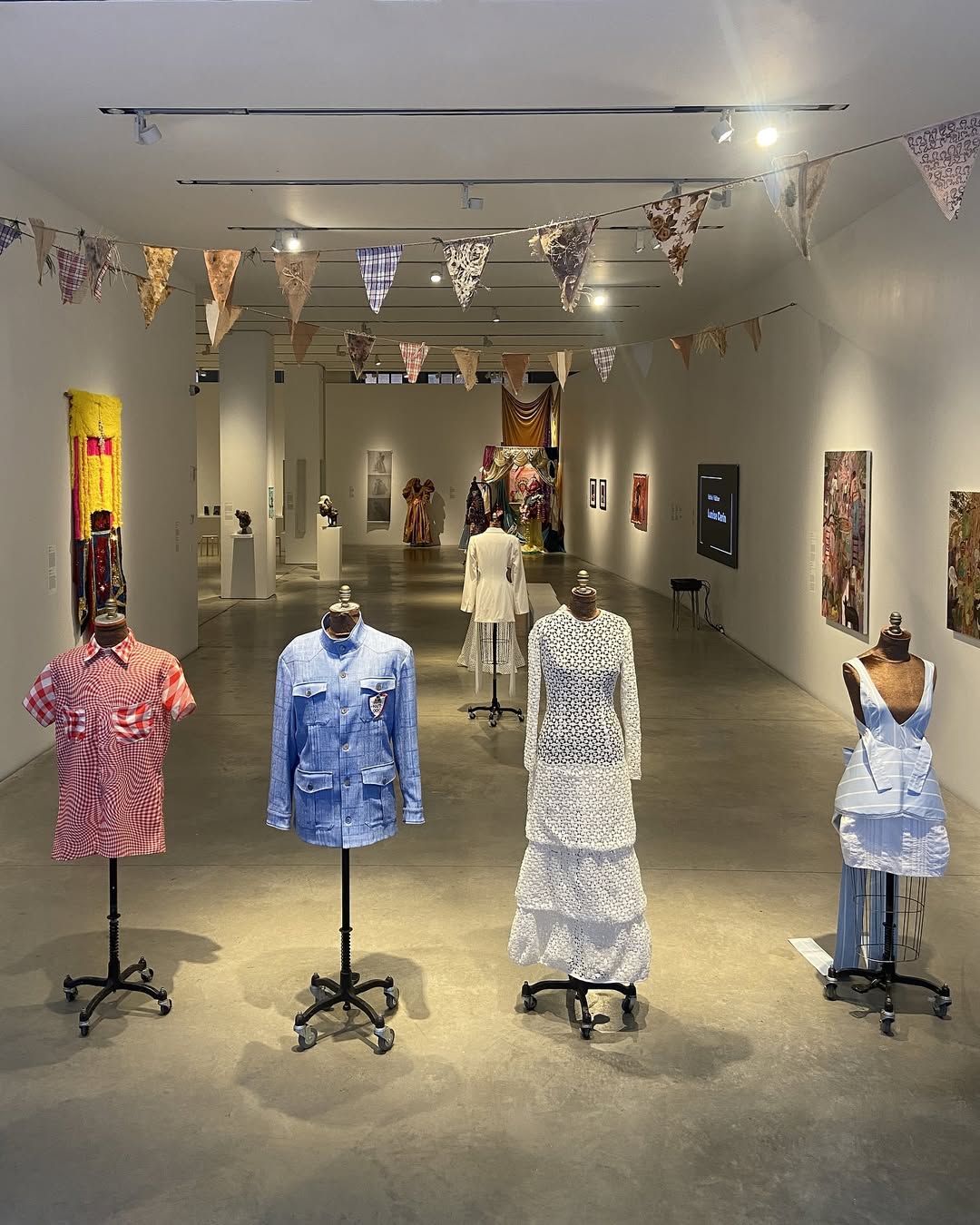
Revolisyon Toupatou was mounted in the Anna-Maria and Stephen Kellen Gallery. Jonathan photographed the installation from the 13th Street window, looking down the full length of the exhibition.
Rendering Revolution was founded out of a desire to center community-based knowledge production across disciplines, professions, and artistic forms within the humanities and more specifically within the study of the African Diaspora. Our exhibition, Revolisyon Toupatou, served as a powerful brick-and-mortar extension of this ongoing work. As part of Revolisyon Toupatou, on January 23, 2025 we convened a public conversation with four Haitian and Haitian-American artists whose work was featured in the show: Daveed Baptiste, Saphyra Saint Fort, Madjeen Isaac, and Steven Baboun. Baboun, Saint Fort, and Baptiste are alumni of Parsons School of Design, making their contribution to the show and their return to campus particularly powerful. Our conversation explored how the Haitian Revolution and its enduring legacies continue to inform the artistic and intellectual practices of contemporary Haitian artists. The participants reflected on their personal and professional trajectories, their diasporic identities, and their collective efforts to articulate a visual language that negotiates race, history, spirituality, and cultural memory.
Throughout the dialogue, the panelists emphasized the centrality of the Haitian Revolution not only as a historical event, but as a living, spiritual, and material force that animates their creative work. They described drawing upon the iconography of resistance, the natural resources of Haiti, and ancestral memory as sources of inspiration. Their practices span a range of media, including photography, millinery, painting, fashion design, and filmmaking—each deploying different strategies to engage with Haiti’s revolutionary past and their diasporic realities.
A significant portion of the discussion addressed the structural challenges faced by students of color within predominantly white art schools. Each artist recounted their struggles navigating cultural misrecognition, financial barriers, and institutional expectations that often failed to accommodate non-Eurocentric perspectives. Despite these obstacles, the panelists underscored the importance of resilience, mutual support, and building communities of care both within and beyond institutional frameworks.
The panel concluded with reflections on the future of Haitian art and design. The participants expressed optimism about the growing global visibility of Haitian artists, while also emphasizing the transnational connections sustained through digital platforms, community work, and diasporic solidarity. As they navigate complex cultural, political, and economic landscapes, the artists envision a dynamic and expansive future for Haitian creative expression.

Revolisyon Toupatou opened with an artist talk bringing together several exhibition artists and Parsons alums. Here Saphyra Saint Fort shares her reflections with the audience.
This transcription has been edited and shortened for clarity.
Jonathan Michael Square
This exhibition centers the legacy of the Haitian Revolution as it manifests in contemporary art and design. Can you speak to how this legacy interacts with/informs your own artistic practice?
Daveed Baptiste
It’s an honor to return to Parsons. My practice draws heavily on the symbolism and material culture tied to Haiti’s colonial past—sugar, coffee, indigo—what was once extracted from the island. In my work, I use these materials to tell stories about Haiti’s history and resilience. For a recent project, I shot my collection in Little Haiti, Miami, which felt historic as perhaps the first fashion collection shot there by a Haitian American. We incorporated the èt, a traditional headwrap, which for me symbolizes revolutionary blood and our collective freedom.
Saphyra Saint Fort
I also draw on this legacy, especially from a spiritual perspective. My mother once told me she wished she could have pursued the path I’m on now. I see my work as a continuation of my ancestors' fight for freedom. The crowns I make honor those who fought without ever knowing I would exist, and I feel a duty to create for them.
Madjeen Isaac
My work merges the landscapes of Brooklyn and Haiti. Growing up in Flatbush, I didn’t fully appreciate my Haitian heritage until I visited Haiti as an adult. There, I was struck by the vibrancy of everyday life, and I aim to recreate these lush, intimate worlds in my paintings. My work explores community, nostalgia, and how diasporic identities maintain ties to the land and culture. Interestingly, I only fully learned Haitian history when I reached college—it was not part of my early education.
Steven Baboun
I see my work as inherently revolutionary because it challenges dominant narratives. Growing up in Haiti, I experienced an alternative reality, not the whitewashed version often portrayed. The spiritual dimension of the revolution deeply informs my work. My installation incorporates textiles tied to Vodou spirits, referencing the ways the revolution was both physical and spiritual. This spiritual fire continues to animate Haitian creativity.
Jonathan Michael Square
This exhibition centers the legacy of the Haitian Revolution as it manifests in contemporary art and design. Can you speak to how this legacy interacts with/informs your own artistic practice?
Daveed Baptiste
It’s an honor to return to Parsons. My practice draws heavily on the symbolism and material culture tied to Haiti’s colonial past—sugar, coffee, indigo—what was once extracted from the island. In my work, I use these materials to tell stories about Haiti’s history and resilience. For a recent project, I shot my collection in Little Haiti, Miami, which felt historic as perhaps the first fashion collection shot there by a Haitian American. We incorporated the èt, a traditional headwrap, which for me symbolizes revolutionary blood and our collective freedom.
Saphyra Saint Fort
I also draw on this legacy, especially from a spiritual perspective. My mother once told me she wished she could have pursued the path I’m on now. I see my work as a continuation of my ancestors' fight for freedom. The crowns I make honor those who fought without ever knowing I would exist, and I feel a duty to create for them.
Madjeen Isaac
My work merges the landscapes of Brooklyn and Haiti. Growing up in Flatbush, I didn’t fully appreciate my Haitian heritage until I visited Haiti as an adult. There, I was struck by the vibrancy of everyday life, and I aim to recreate these lush, intimate worlds in my paintings. My work explores community, nostalgia, and how diasporic identities maintain ties to the land and culture. Interestingly, I only fully learned Haitian history when I reached college—it was not part of my early education.
Steven Baboun
I see my work as inherently revolutionary because it challenges dominant narratives. Growing up in Haiti, I experienced an alternative reality, not the whitewashed version often portrayed. The spiritual dimension of the revolution deeply informs my work. My installation incorporates textiles tied to Vodou spirits, referencing the ways the revolution was both physical and spiritual. This spiritual fire continues to animate Haitian creativity.
“The materials produced, curated, and translated for this project focus on the activities of occluded figures in history as well as the testimonies of contemporary designers and artists, focusing particularly on women and members of the LGBTQIA+ community.”
Siobhan Meï
What is the role of art and design in a world that is increasingly digital/digitized? And how does this impact your own understanding of authenticity and ownership?
Steven Baboun
Digital tools have a role, but I value the human, tactile process. There’s an irreplaceable intimacy in physically constructing work with one’s hands, something I associate with the women in my family. Digital platforms can’t replicate that depth of connection, although they offer new spaces for dissemination.
Daveed Baptiste
As someone who works in both photography and design, I have mixed feelings about AI. It’s both inspiring and unsettling. I’ve seen AI used as a tool for iteration in the design industry, particularly at Nike, where it aids but does not replace the creative process. Ultimately, AI depends on human input—it cannot exist without artists’ labor.
Saphyra Saint Fort
I agree. While AI may assist certain aspects of creation, it can never replicate the full emotional, physical, and spiritual labor embedded in our work. The act of creating involves pain, joy, and lived experience—things a machine cannot duplicate.
Madjeen Isaac
I choose not to use AI. My studio practice is therapeutic, a space of personal grounding. The pressures of social media can be overwhelming, and I prefer creating in a space of joy, away from those anxieties.
Jonathan Michael Square
For Saphyra, Daveed, and Steven, what were your experiences like navigating Parsons as students of color?
What is the role of art and design in a world that is increasingly digital/digitized? And how does this impact your own understanding of authenticity and ownership?
Steven Baboun
Digital tools have a role, but I value the human, tactile process. There’s an irreplaceable intimacy in physically constructing work with one’s hands, something I associate with the women in my family. Digital platforms can’t replicate that depth of connection, although they offer new spaces for dissemination.
Daveed Baptiste
As someone who works in both photography and design, I have mixed feelings about AI. It’s both inspiring and unsettling. I’ve seen AI used as a tool for iteration in the design industry, particularly at Nike, where it aids but does not replace the creative process. Ultimately, AI depends on human input—it cannot exist without artists’ labor.
Saphyra Saint Fort
I agree. While AI may assist certain aspects of creation, it can never replicate the full emotional, physical, and spiritual labor embedded in our work. The act of creating involves pain, joy, and lived experience—things a machine cannot duplicate.
Madjeen Isaac
I choose not to use AI. My studio practice is therapeutic, a space of personal grounding. The pressures of social media can be overwhelming, and I prefer creating in a space of joy, away from those anxieties.
Jonathan Michael Square
For Saphyra, Daveed, and Steven, what were your experiences like navigating Parsons as students of color?
 The exhibition included a “ti kwen biblioyotèk,” or library nook, highlighting the scholars and artists who informed our curatorial process. Some titles came from our personal collections, and others were provided in partnership with The New School Libraries.
Saphyra Saint Fort
While I valued the diversity of the student body, I often felt invisible to faculty who didn’t understand or value my perspective. Professors often looked for trends or ideas they could easily categorize, and if you didn’t fit their mold, you received less attention. Financial struggles were also a major burden—I worked throughout my studies while managing heavy coursework and critiques that often failed to recognize the cultural significance of my work.
Daveed Baptiste
Many of us shared that experience. Professors often tried to fit our work into a narrow framework—if it wasn’t legible through Eurocentric lenses, it was dismissed. Beyond race, class differences were stark. Many classmates came from wealth, outsourcing production while I juggled multiple jobs. Yet these hardships taught me resilience and discipline. I watched many peers drop out because they couldn’t financially sustain their studies. But I see now that many of us who endured have gone on to succeed in the industry.
Steven Baboun
I share similar sentiments. My work often involved Kreyòl, Vodou, and cultural narratives unfamiliar to faculty. They frequently asked for excessive contextualization—as though my work needed extra explanation for it to be understood. In contrast, Western work was rarely subjected to the same demands. Thankfully, I built a strong community of peers and sought out faculty of color who became mentors. Representation among faculty remains crucial.
Madjeen Isaac
I had to actively seek out community beyond the institution—through internships, residencies, and organizations like Haiti Cultural Exchange. Art school is a tool, not the ultimate destination. Building networks outside of school was essential to finding my voice and seeing possibilities beyond institutional constraints.
While I valued the diversity of the student body, I often felt invisible to faculty who didn’t understand or value my perspective. Professors often looked for trends or ideas they could easily categorize, and if you didn’t fit their mold, you received less attention. Financial struggles were also a major burden—I worked throughout my studies while managing heavy coursework and critiques that often failed to recognize the cultural significance of my work.
Daveed Baptiste
Many of us shared that experience. Professors often tried to fit our work into a narrow framework—if it wasn’t legible through Eurocentric lenses, it was dismissed. Beyond race, class differences were stark. Many classmates came from wealth, outsourcing production while I juggled multiple jobs. Yet these hardships taught me resilience and discipline. I watched many peers drop out because they couldn’t financially sustain their studies. But I see now that many of us who endured have gone on to succeed in the industry.
Steven Baboun
I share similar sentiments. My work often involved Kreyòl, Vodou, and cultural narratives unfamiliar to faculty. They frequently asked for excessive contextualization—as though my work needed extra explanation for it to be understood. In contrast, Western work was rarely subjected to the same demands. Thankfully, I built a strong community of peers and sought out faculty of color who became mentors. Representation among faculty remains crucial.
Madjeen Isaac
I had to actively seek out community beyond the institution—through internships, residencies, and organizations like Haiti Cultural Exchange. Art school is a tool, not the ultimate destination. Building networks outside of school was essential to finding my voice and seeing possibilities beyond institutional constraints.
 In the moments before the program starts, Siobhan Meï and Jonathan Michael Square go over their notes, preparing to introduce the artists to a packed opening night audience.
“Digital tools have a role, but I value the human, tactile process. There’s an irreplaceable intimacy in physically constructing work with one’s hands, something I associate with the women in my family.” - Steven Baboun
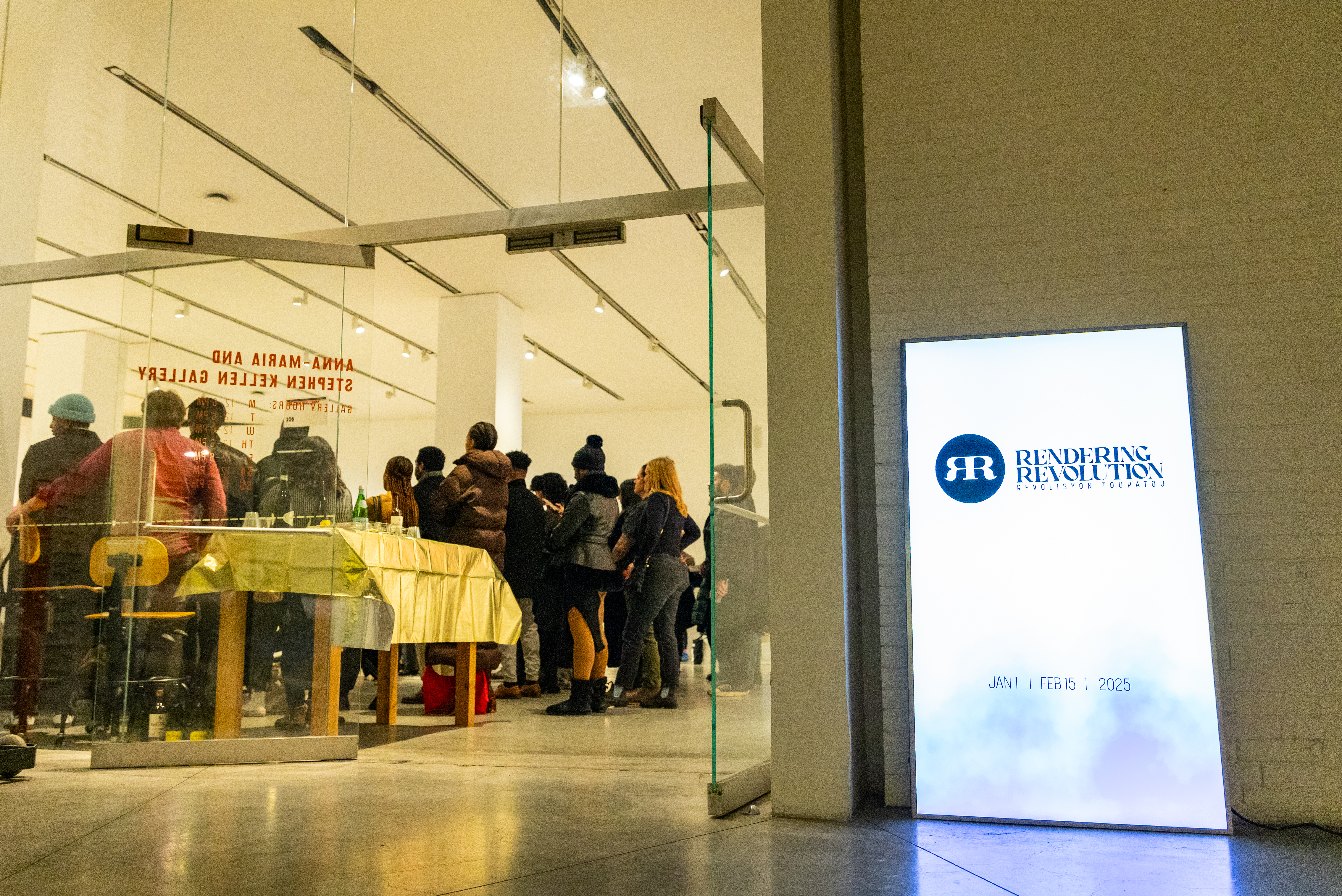 Opening night brought a full house. Seen here from the gallery entrance, visitors fill the space as the program begins.
Siobhan Meï
What does the future of Haitian art and design look like?
Saphyra Saint Fort
Many of us are first-generation Americans. Our parents’ dreams involved securing resources here and contributing back to Haiti. My work seeks to serve both communities, often channeling proceeds into development projects back home—whether schools, churches, or infrastructure. Our presence here allows us to amplify and support those still in Haiti.
Madjeen Isaac
My work explores the tensions and harmonies of hybrid identity—not fully Haitian, not fully American. I aim to create worlds that offer comfort to those negotiating these in-between spaces, affirming the complexity and beauty of diasporic life.
Daveed Baptiste
I’m inspired by the transnational dialogues emerging online, particularly through platforms like Haitian TikTok. Digital spaces allow new generations of Haitians—both on the island and in the diaspora—to connect, share their work, and build community. Humor, resilience, and cultural pride continue to be powerful tools for coping and creating.
Steven Baboun
We are already occupying spaces we once couldn’t imagine—on magazine covers, runways, residencies. A new Haitian art renaissance is unfolding, and we’re at its forefront. I’m incredibly hopeful for what the next 10, 20, 50 years will bring.
Afterword: We were honored to host this conversation as part of the programming for the exhibition. We continue to value the labor of artists, designers, and translators, particularly in light of the current political climate in the United States. As we write, the U.S. government is actively restricting the free movement of Haitians while perpetuating the violent criminalization and incarceration of Black and brown communities. We believe that art remains essential to collective liberation, and in this spirit, we share the optimism expressed by Baptiste, Isaac, Saint Fort, and Baboun. We, too, believe that another world is possible.
What does the future of Haitian art and design look like?
Saphyra Saint Fort
Many of us are first-generation Americans. Our parents’ dreams involved securing resources here and contributing back to Haiti. My work seeks to serve both communities, often channeling proceeds into development projects back home—whether schools, churches, or infrastructure. Our presence here allows us to amplify and support those still in Haiti.
Madjeen Isaac
My work explores the tensions and harmonies of hybrid identity—not fully Haitian, not fully American. I aim to create worlds that offer comfort to those negotiating these in-between spaces, affirming the complexity and beauty of diasporic life.
Daveed Baptiste
I’m inspired by the transnational dialogues emerging online, particularly through platforms like Haitian TikTok. Digital spaces allow new generations of Haitians—both on the island and in the diaspora—to connect, share their work, and build community. Humor, resilience, and cultural pride continue to be powerful tools for coping and creating.
Steven Baboun
We are already occupying spaces we once couldn’t imagine—on magazine covers, runways, residencies. A new Haitian art renaissance is unfolding, and we’re at its forefront. I’m incredibly hopeful for what the next 10, 20, 50 years will bring.
Afterword: We were honored to host this conversation as part of the programming for the exhibition. We continue to value the labor of artists, designers, and translators, particularly in light of the current political climate in the United States. As we write, the U.S. government is actively restricting the free movement of Haitians while perpetuating the violent criminalization and incarceration of Black and brown communities. We believe that art remains essential to collective liberation, and in this spirit, we share the optimism expressed by Baptiste, Isaac, Saint Fort, and Baboun. We, too, believe that another world is possible.
Issue 15 ︎︎︎
Fashion & Southeast Asia
Issue 14 ︎︎︎
Barbie
Issue 13 ︎︎︎ Fashion & Politics
Issue 13 ︎︎︎ Fashion & Politics